Safety is not a metric. It's a culture.
This post covers how Crusoe approaches safety across our construction sites and manufacturing facilities, including our TRIR performance relative to national benchmarks, the safety culture systems we have built, and how our HSE organization scales with the business.
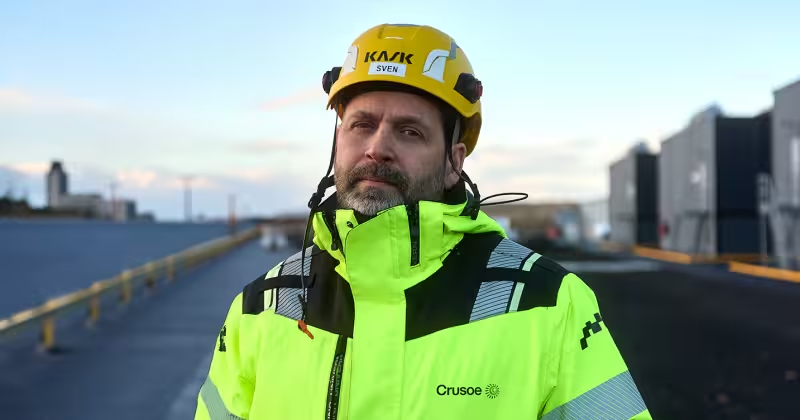
At Crusoe, the safety and well-being of every worker at our construction sites and manufacturing plants is our top priority. Together with our contractor partners, we build to the highest standards of safety and compliance, and our safety performance consistently outperforms the national industry average, according to the Bureau of Labor Statistics. That commitment isn't abstract. It's reflected in our data, our systems, and the people we're hiring to make sure our safety organization scales with the ambition of what we're building.
Think like a mountaineer
One of Crusoe's core values is "Think Like a Mountaineer" — a mindset that treats discipline and preparation as prerequisites for ambition. In the mountains, speed without judgment often results in serious injury. The same is true while building at gigawatt scale.
That's why our safety culture at Crusoe isn't a single department. It's a shared language that spans every team. Thousands of employees and contractors follow the same playbook, hold each other to the same standard, and move the way a climbing team moves: together, deliberately, and only as fast as the whole system can move safely.
Our safety performance
Across our construction operations, Crusoe's safety performance significantly outpaces industry benchmarks. At our Texas campuses under construction, with nearly 23 million worker hours logged, our Total Recordable Injury Rate (TRIR) is approximately 2.5 times better than the nonresidential construction industry average, according to the Bureau of Labor Statistics. And, there have been zero work-related fatalities across any of our operations.
A Total Recordable Injury Rate (TRIR) measures the number of recordable incidents per 100 workers, normalized against a standard 200,000-hour baseline established by OSHA. It is the construction industry's primary yardstick for safety performance.
At our Crusoe Industries manufacturing facilities in Tulsa, Arvada, and Ponchatoula, our TRIR score places us better than the average across the American manufacturing sector, with more than 356,000 hours logged, we also have below-average injury rates and zero work-related fatalities across any of our facilities. We're actively investing in our manufacturing safety and training programs to improve that number in line with our construction numbers. Our ultimate goal is to bring both numbers to zero.
What safety culture looks like
Good safety performance doesn't happen by accident. It's the result of specific, accountable systems:
- Daily pre-task planning that identifies hazards before work begins
- Open reporting channels so workers can raise concerns without fear
- A governance framework spanning hazard identification, defined procedures, training and communication, program monitoring, and continual improvement.
We take every incident seriously, and when one does occur we take the opportunity to learn from it and put controls in place to mitigate any going forward.
We're continuing to hire across our Health & Safety and Environment (HSE) teams, to include corporate program leaders as well as manufacturing and construction site HSE leads, because the scale of what we're building demands a safety organization that scales with it.
Our hiring practices
Crusoe fully complies with all state and federal employment laws. All licensed-trade work is performed by credentialed professionals in accordance with applicable code and contract requirements.
What we're building toward
The projects we're delivering — gigawatt-scale AI infrastructure campuses that will power the next era of American technological capability — are among the most consequential construction efforts underway in the country today. The people building them deserve to go home safe every day. It's the standard we hold ourselves to, and the one our safety data reflects.