Water stewardship at our data centers: What it means for the communities we call home
Crusoe designs AI data centers with closed-loop, non-evaporative cooling that protects local water supplies. From native landscaping to efficient fixtures, every design choice reflects our commitment to being a responsible, long-term neighbor.


Water is foundational to everyday life, from drinking water and agriculture to local businesses and ecosystems. When new infrastructure is built, it’s reasonable for communities to ask: What does this mean for our water supply?
At Crusoe, we design AI data centers with that question front and center. Our goal is simple: operate in a responsible way that respects local water resources, avoids unnecessary strain on shared supplies, and supports long-term resilience; especially in regions where water is already scarce.
This starts with how our facilities are designed, how they’re cooled, and how we think about responsibility beyond our fence line.
Why data centers are often associated with water use
Data centers are critical because they’re the backbone of almost everything we do online. They house computing equipment that stores, processes, and moves information. Every time you send a message, stream a movie, check your bank account, use GPS, or ask AI a question, you’re relying on data centers somewhere to do that work. The equipment that enables all of these activities runs 24/7 and generates a lot of heat. Without cooling, they would quickly overheat, malfunction, or even fail permanently. Cooling keeps the equipment operating at safe temperatures so it can run reliably and securely.
AI workloads run on very powerful computer chips designed to process huge amounts of data at once. These chips are denser and work much harder than traditional computers and servers and, as a result, generate even more heat that must be dissipated in order to operate effectively.
Cooling isn’t optional—it’s essential for keeping digital services running. But how cooling is done matters. At Crusoe, we utilize a closed-loop, non-evaporative cooling system that uses less water to cool than traditional data centers.
Traditional data centers often rely on evaporative cooling systems to remove heat. In order to cool these data centers, water is evaporated into the air (similar to how sweat evaporates to cool your skin) and must constantly be replaced. This requires large volumes of water to be continually withdrawn and released into the atmosphere. According to the Washington Post, a large data center that uses this form of cooling can use upwards of five million gallons daily, equivalent to the water needs of a town of 50,000 households.
This is not how Crusoe builds our data centers.
A different approach: Cooling without ongoing water consumption
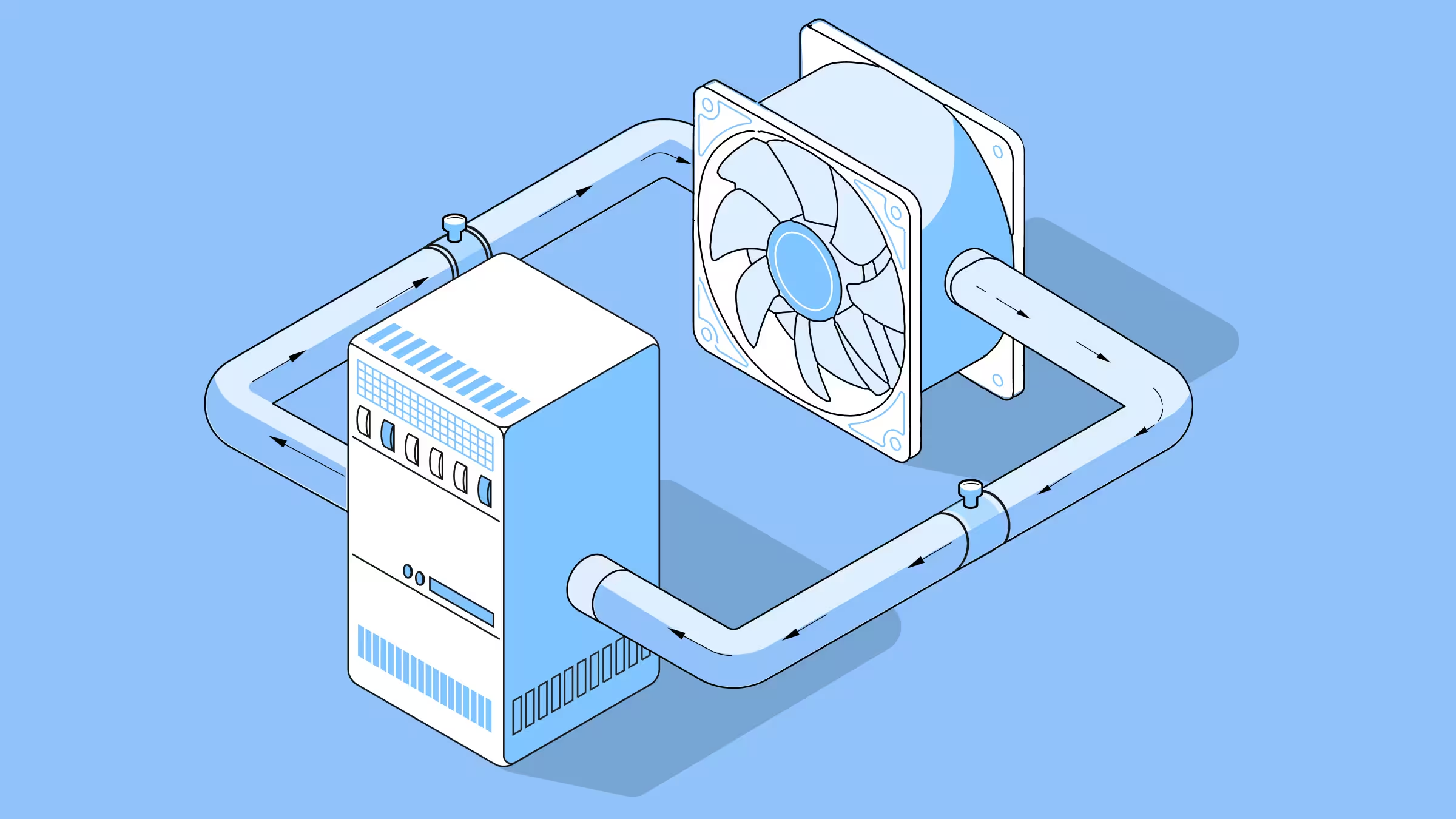
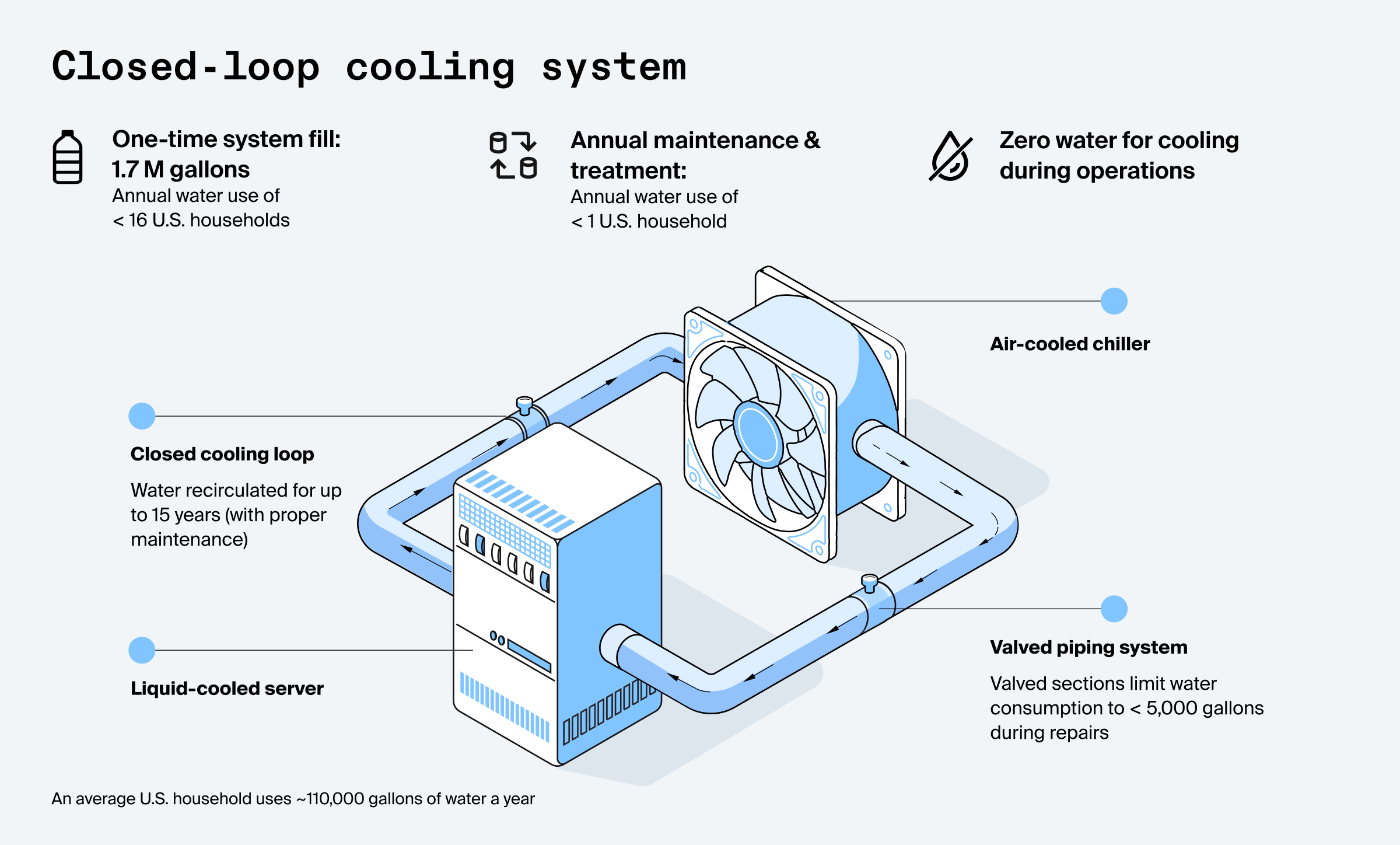
Crusoe designs and builds data centers with closed-loop, non-evaporative cooling systems. Instead of consuming water to remove heat, these systems continuously recirculate cooling media through a sealed loop. Hence there is no routine water loss through evaporation for cooling purposes making Crusoe’s approach significantly more water efficient.
The initial fill of a typical system requires approximately 1,700,000 gallons of water, or the equivalent annual water use of less than 16 average U.S. households.1 Once filled, a full drain-down and refill of the system isn’t necessary, even when repairs or upgrades are necessary. The system is designed with valved sections of piping, to limit the amount of drain and refill if a repair is needed. If a repair is necessary, we would valve off the section that needs repair, and only that section would be drained and refilled after repairs, limiting consumption to about 5,000 gallons in most cases.
Because cooling is typically the largest driver of water use in data centers, eliminating evaporative cooling dramatically reduces our overall water demand. This design allows our facilities to achieve a near-zero Cooling Water Usage Effectiveness (CWUE) — an industry metric that tracks how much water is used for cooling relative to IT energy consumption.
Designing the entire site with water in mind
Of course, cooling is just one part of the picture. We also apply water-conscious design principles and operational best practices across our sites.
Landscaping that fits the environment
When we design the landscaping at our sites, we use native and climate-adapted plants that don’t require permanent irrigation. This reduces outdoor water use while supporting local ecosystems and landscapes that belong in the region.
Efficient plumbing fixtures
Our data centers are also workplaces for our employees and those of our tenants, with restrooms, kitchens and break areas, just like any other building. When designing these spaces inside the facility, we make sure that they are as efficient as possible. That means using water-efficient fixtures, including faucets and toilets that meet strict efficiency standards (including the U.S. EPA’s WaterSense program) and reduce water use without sacrificing functionality.
Maintenance best practices
Even with water-efficient cooling systems and design, responsible operations require ongoing maintenance to prevent unnecessary water use. Best practices include daily inspections and prompt repair of leaks in piping, valves, and equipment. Flow sensors and leak detectors provide early warning of issues, and above-grade piping ensures any leaks are immediately visible and not hidden. The cooling loop is also protected with standard corrosion and bacterial inhibitors, helping maintain system integrity and reduce the risk of water loss over time.
What water is needed?
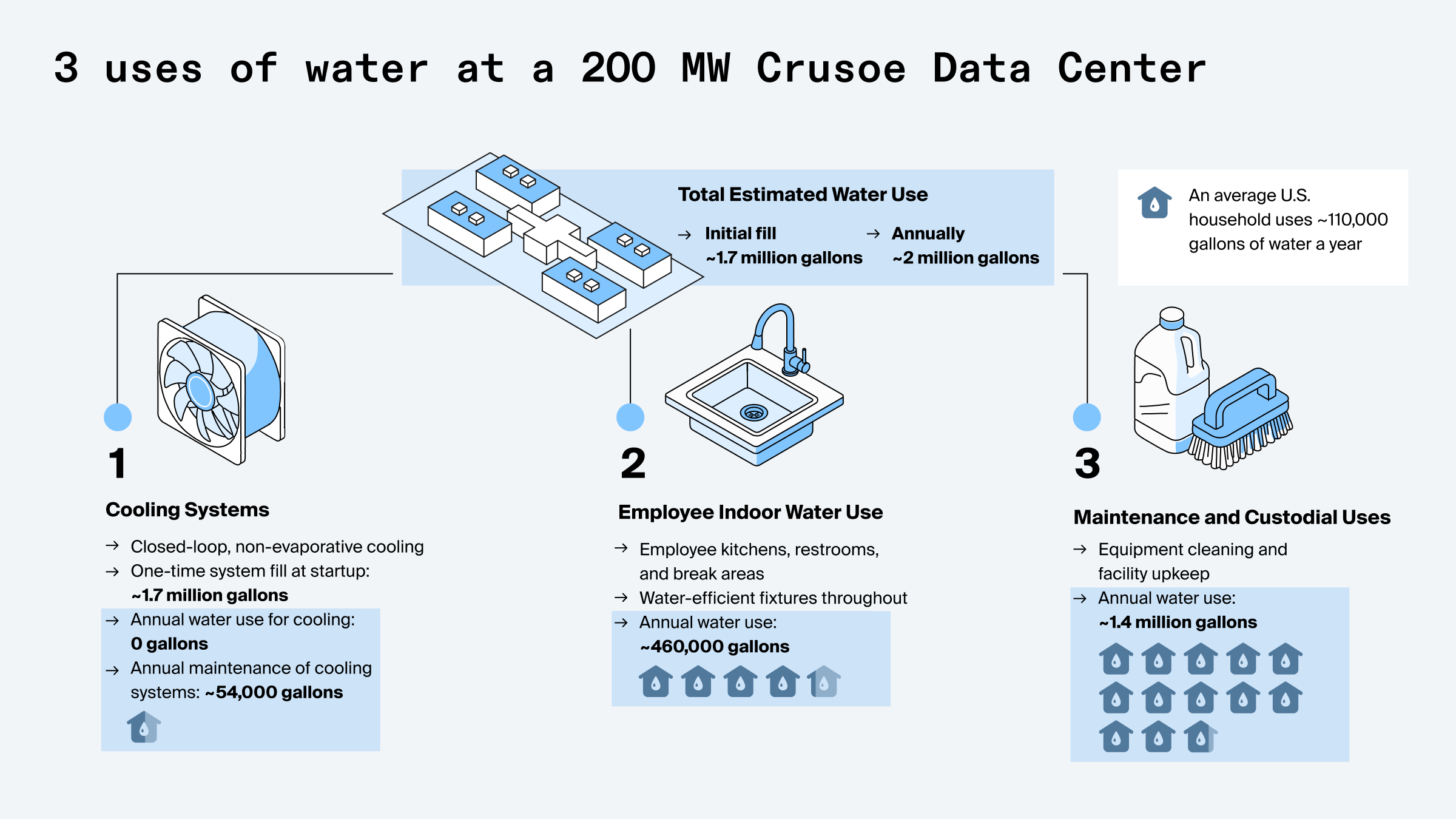
Below is an illustrative breakdown showing how water is used at a Crusoe-designed 200 MW data center. Because our cooling does not rely on evaporation, the majority of our operational water needs is limited to essential everyday domestic water use by employees in kitchens, break areas and restrooms, custodial services, and equipment maintenance.
Building for reliability and the long term
Reducing water dependence isn’t just about conservation, it’s also about resilience and long-term business operations. Droughts and extreme heat are increasing in many parts of the country. Because our data centers use less water, we’re able to maintain our operations over the long term while protecting local resources. This limits strain on local water supplies, especially during periods of hot weather or droughts, while still delivering the reliable digital services people depend on every day. That resilience benefits both us and the communities around our data centers.
Demand for digital infrastructure and AI is growing rapidly and we believe that growth should be thoughtful, transparent, and in support of local communities and their priorities. By designing data centers that minimize water use, we aim to be good long-term neighbors — supporting economic development while protecting one of our most important shared resources.
1According to the EPA, an average U.S. household uses more than 300 gallons of water a day at home, which is approximately 110,000 gallons a year.
.jpg)
.jpg)