AI infrastructure spend: a framework for evaluating cost, risk, and vendor choice
The quoted hourly rate is only part of what AI infrastructure costs. A three-provider study put the three-year gap at 36% against the hyperscaler, split between compute and the team needed to run it, plus four questions to ask before signing.



For many teams, AI infrastructure has become a significant line item that deserves the same scrutiny we apply to any other major spend decision. The instinct is to focus on the headline number, the rate a vendor quotes per hour of compute, but that figure is only part of the story. The true cost comes down to three things moving together: the price you're quoted, how much staff time it takes to get the system running and keep it running, and how much useful work you actually get out of it.
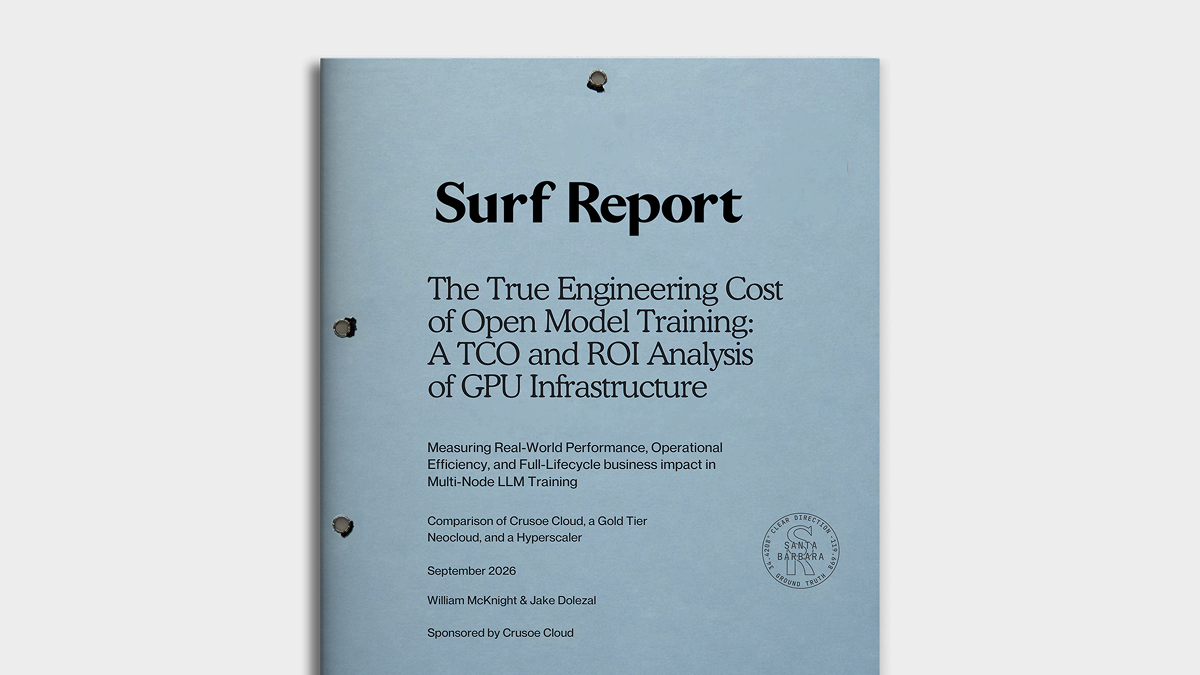
An independent study sponsored by Crusoe Cloud "The True Engineering Cost of Open Model Training: A TCO and ROI Analysis of GPU Infrastructure" conducted by Surf Report tested this across three providers, and the results make the case plainly: the provider with the lowest quoted price was not the one that delivered the lowest total cost.
This is the logic behind AI tokenomics: the practice of tracking cost and efficiency at the token level rather than the invoice line. Four metrics provide a more comprehensive look at the value you're getting from your AI infrastructure investments.
- Tokens per watt ties output to the power it took to produce it. Think of it as the total amount of intelligence an AI factory can produce.
- Cost per token is the true unit cost. It takes into account downtime and other efficiencies (or inefficiencies) behind delivering a token instead of just the compute consumed producing it.
- Cost per completed task accounts for retries and failures rather than raw throughput; an increasingly important measure for agentic workloads.
- Goodput is the share of paid compute that turns into meaningful output instead of being lost to errors or overhead. It's the token output that actually advances a task toward completion within acceptable latency.
The infrastructure underneath a model doesn't just host it, it determines where a team lands on each of these four measures.
Cost, ease of use, and performance are one decision, not three
A credible ROI calculation for the AI infrastructure running underneath your workloads has four ingredients:
- Compute cost, modeled over several years of realistic use, not a single quote.
- Staffing cost, the size of the team needed to operate the system day to day.
- Time to get up and running, since every week of delay before a team is productive is a real cost.
- How much time you paid for actually becomes usable compute, as addressed below under reliability.
The study modeled three-year costs of comparable workloads across Crusoe Cloud, a competing neocloud, and the hyperscaler. The hyperscaler came in with the highest cost at $8.37M, followed by the competing neocloud at $6.14M, and Crusoe Cloud at $5.36M. That's a 56% better ROI for Crusoe Cloud over the hyperscaler, and 15% over the next-best neocloud, worth $3.01M and $780K respectively. But the more interesting number sits underneath those totals.
Roughly $1.27M of Crusoe Cloud's savings compared to the hyperscaler came from staffing rather than the rate card, because running the platform required just under four people, versus more than six on the hyperscaler. That's the practical case for modeling compute cost over years of realistic use rather than a single quote, GPU per hour pricing doesn't reflect the resourcing needed to bring that compute online, and that resourcing is where a meaningful share of the real cost, and the real savings, actually sits.
Track cost per unit of work, not cost per hour
The price per hour of compute answers a singular question only. It tells you what you're charged, not what you get. Two providers can charge the same hourly rate and produce very different amounts of finished work in that hour, depending on how fast and how reliable the system is. A cheaper rate on a slower or less dependable system can end up costing more.
A better metric is cost per unit of completed work, the total spend (compute plus the staff needed to run it) divided by what actually got produced. It's the same logic as any unit-economics analysis: judge cost by output, not by the invoice line. In AI tokenomics terms, this is the shift from a raw hourly rate to cost per token and cost per completed task; measures that capture agent retries and GPU restarts a rate card never shows.
In the study, GPU cost per 1 million training tokens (GPU rate times step time, before staffing and downtime) came in about 13% lower on Crusoe Cloud than on the competing neocloud and about 34% lower than on the hyperscaler. The hourly rate alone would never have shown that gap.
Why reliability drives cost more than people expect
A system can look fast on paper and still be expensive in practice if it loses time every time something breaks. The study measured goodput, the share of billed compute time that turns into completed training progress, alongside raw throughput, the tokens-per-second number most teams default to. Throughput counts all the work a system does, including work later lost to a failure and rolled back. Goodput counts the output that actually advances a task toward completion. The test injected three failures, two pod evictions and a node cordon, so recovery time and lost progress are factored in. Goodput also feeds the cost per effective compute-hour, where Crusoe Cloud came in at $9.04 vs. $12.20 on the hyperscaler's matching hardware.
In a stress test that deliberately introduced failures partway through a multi-day job, Crusoe Cloud kept 99% of paid computing time productive, versus roughly 94% and 96% for the other two providers, and recovered from each disruption in about 9 minutes on an already-warm node, versus roughly 13 to 14 minutes for the others. Over a long-running project, that difference compounds into real money and real time saved.
How to evaluate an AI cloud partner
When evaluating AI cloud partners, four questions can help you see the big picture, in this order:
- How much staff time does it take to get started and to keep it running?
- What is the true three-year cost, including staffing and not just the compute rate?
- What does a unit of finished work actually cost, measured under normal, imperfect conditions?
- Does the provider own the full stack, or does our team have to stitch several vendors' pieces together ourselves?
The first three questions apply to any provider. The fourth is where the answer diverges most sharply, and it matters most during periods of fast growth, when you need a cloud partner that can scale with you while keeping economics predictable and expansion straightforward.
Crusoe's vertically integrated cloud stack means we own the stack end to end, from power and data centers up through the cloud layer, instead of assembling a service from separately priced pieces. Cutting out the markups and integration overhead that come with stitching together multiple vendors means more predictable economics and a simpler experience, one platform to manage instead of several to reconcile.
For teams scaling fast and prioritizing speed and predictability, a single, vertically integrated cloud partner answers that with ease.
What actually improves performance
Four things move the needle, based on the study and the platform design:
- Faster setup: teams were able to reach a first verified training step 14 to 29% faster than on the other two platforms, because the basic setup steps come bundled together instead of requiring manual assembly.
- Built-in detection: Command Center alerted on injected failures in about a minute on average with no monitoring setup, versus roughly 1.7 and 6.5 minutes on the other two platforms.
- Faster networking and storage included by default, rather than sold as separate add-ons, which the report credits for quicker checkpointing and recovery.
- Automatic pod rescheduling with CMK and AutoClusters: when a pod is evicted or a node is cordoned, the workload reschedules onto already-initialized capacity and resumes from checkpoint, which kept recovery to about 9 minutes with zero lost steps.
Bottom line
The hourly rate is only part of the real cost story. What determines the three-year bill is how many people it takes to run the platform, how much of what you pay for turns into finished work, and how much integration work your own team has to do. On those measures, the independent study found Crusoe Cloud came out ahead, more than a third cheaper than the hyperscaler and modestly cheaper than the next-best neocloud, with a meaningfully higher return over three years, as detailed in the report. It also delivered the lowest cost per training token ($2.89, vs. $3.32 and $4.39) and the highest Goodput under injected failures (99.1%, vs. 94.2% and 95.9%).
Crusoe Cloud integrates orchestration, networking, storage and observability in one control plane, so there is one platform to manage instead of several to reconcile.
For a deeper look at how tokens per watt, cost per token, cost per completed task, and Goodput play out in agentic, multi-step inference workloads specifically, see Crusoe and NVIDIA's Tokenomics in the Age of Agentic Inference.
Full methodology and underlying data are available in the complete 2026 The True Engineering Cost of Open Model Training: A TCO and ROI Analysis of GPU Infrastructure.
Read the full report.
The competing neocloud was tested on NVIDIA HGX™ B200 GPUs because NVIDIA HGX™ B300 GPUs weren't available on demand.
Full report sponsored by Crusoe Cloud. Testing and analysis by Surf Report.
Frequently
asked questions
How much does AI infrastructure cost?
Total cost depends on staffing and utilization as much as on the quoted hourly rate. "The True Engineering Cost of Open Model Training," an independent Surf Report study of three providers sponsored by Crusoe Cloud, modeled three-year costs of $5.36M on Crusoe Cloud, $6.14M on a competing neocloud, and $8.37M on a hyperscaler for comparable workloads. Roughly $1.27M of Crusoe's advantage over the hyperscaler came from headcount, not rate card.
How is total cost of ownership calculated for AI infrastructure?
A credible TCO model for AI infrastructure has four inputs: compute modeled over several years rather than a single quote, the size of the team needed to operate the platform, the time it takes to get up and running, and the share of paid compute that turns into finished work. The Surf Report study found compute efficiency and staffing drove the gap, about $1.74M and $1.27M against the hyperscaler.
What is the difference in operational efforts between a hyperscaler and a neocloud?
A hyperscaler sells AI infrastructure as separately priced services that the customer integrates, while a neocloud is a GPU-specialist provider that bundles more of the stack. The Surf Report study found hyperscaler teams spent noticeably more engineering time connecting services.
How much does AI training typically cost?
Cost per GPU-hour understates training cost, because two providers can charge the same rate and finish different amounts of work. A more useful measure is cost per unit of output. On GPU cost per 1 million training tokens, The Surf Report study found Crusoe Cloud about 13% cheaper than a competing neocloud and 34% cheaper than the hyperscaler. Under induced failures, Crusoe Cloud also kept 99% of paid compute productive, versus roughly 94% and 96% for the other two.