Why Crusoe chose ON.energy’s medium-voltage AI UPS solution for grid-safe AI infrastructure
Crusoe is deploying 5 GW of ON.energy AI UPS so its campuses ride through disturbances instead of adding to them, while cutting the energy waste of flat-load workarounds.


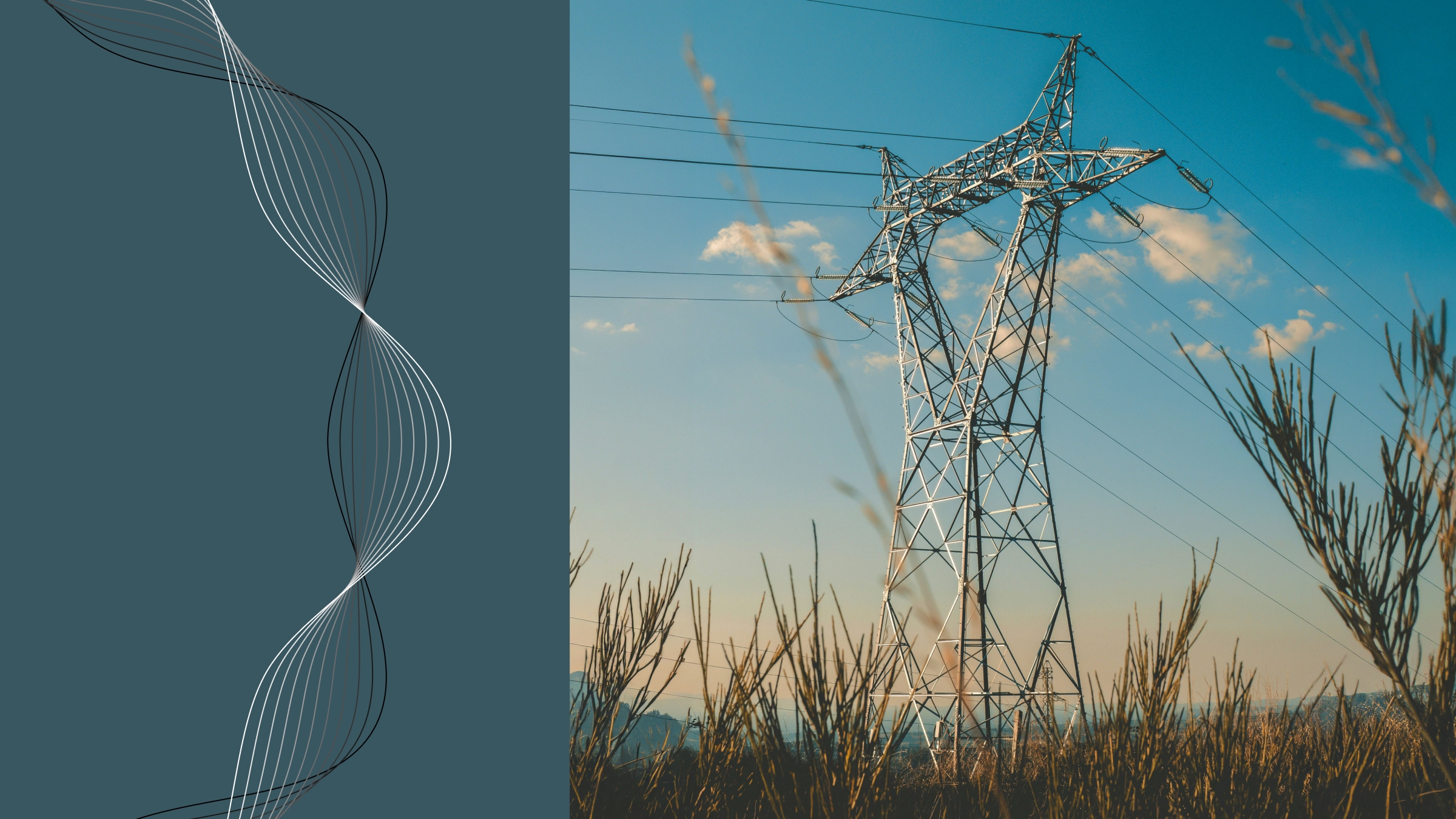
In July, a single downed power line in northern Virginia, a core data center hub, caused data centers to disconnect from the PJM grid nearly simultaneously, briefly pulling more than 3 gigawatts of load offline in about 30 seconds, twice the scale of a comparable event in 2024.
As TechCrunch reported, the resulting voltage swing rippled across the grid from Northern Virginia to Chicago, causing visible flickering for homes and businesses. It took grid operators roughly 10 minutes to restore balance.
Incidents like this are accelerating industry-wide interest in battery energy storage systems (BESS), which are increasingly deployed to help large, volatile loads stay connected to the grid rather than disconnect.
The way AI infrastructure interacts with the grid is now a design decision, not an afterthought. It is why Crusoe is partnering with ON.energy on an approach that supports the grid during strain instead of walking away from it.
AI’s grid management challenges
For decades, grid operators managed power demand from relatively predictable loads such as factories, office buildings, and traditional data centers. These consumers were diverse, distributed, and the peaks and valleys of their energy demand rarely aligned. The result was a grid that could be planned and balanced with reasonable confidence.
Generative AI breaks that assumption. AI workloads do not draw power the way other loads do, which introduces two grid management challenges that barely existed before: chronic power fluctuations under normal operations, and acute grid stress during disturbance events.
Power fluctuations: Everyday volatility at scale
Modern AI training runs require thousands of GPUs working in perfect synchrony, cycling between intense bursts of computation and quieter communication phases, sometimes dozens of times an hour. During the communication phase, power draw drops dramatically. Then the compute phase resumes and demand spikes, instantaneously.
At scale, this oscillation is enormous. A single large training cluster can swing its power demand by tens or even hundreds of megawatts in less than a second, forcing grid operators and utilities to reconsider how AI clusters connect to the grid. Left unmanaged, those swings can induce voltage flicker, harmonic disturbances, and frequency instability, stressing grid infrastructure that was never designed for synchronized load cycling at this magnitude.
Low Voltage Ride-Through: Managing grid disturbance events
The second challenge is different in nature. It arises not from AI's everyday behavior, but from how data centers respond when volatility appears on the grid.
Data centers are typically built with low voltage uninterruptible power supply (UPS) systems designed to instantly disconnect the facility from the grid and switch to backup power the moment volatility occurs, protecting sensitive servers and GPUs. Under normal circumstances, this is good engineering. But as AI campuses have grown into some of the largest loads on regional grids, the collective behavior of many facilities doing this simultaneously creates a new risk to the grid.
When a voltage disturbance causes many large data centers to disconnect simultaneously, the grid suddenly loses thousands of megawatts of demand and swings into an abrupt power imbalance.
That imbalance can trigger its own wave of voltage and frequency fluctuations, potentially leading to a blackout. Grid operators in Texas and elsewhere have taken note. ERCOT has established formal Large Low Voltage Ride-Through (LLVRT) requirements for large loads, codified under NOGRR 282, asking data centers to stay connected to and supportive of the grid during disturbance events rather than retreating to backup power.
The flawed "solution”: Why constant power draw is wasteful
Faced with the challenge of wild power fluctuations, the industry's initial instinct was simple: just keep the power draw constant. Don't let it spike or drop. Hold it flat.
There are two common approaches to this:
Software-based “dummy” workloads
To maintain a flat, predictable power draw from the grid, training clusters often use software to inject artificial computational work (meaningless matrix multiplications) when GPUs would naturally experience a dip in power during communication phases. This practice, known as using a "dummy load," stabilizes the power consumption but comes at a significant cost.
The drawback is energy that produces nothing. The fake workloads generate no useful output, and the overhead runs slightly under 6%, though this varies by model. For a 1 gigawatt (GW) facility, that is roughly 480 GWh lost per year.
Furthermore, this wasted energy exacerbates the cooling demands of the data center. The heat generated by the “dummy loads” requires an additional 192 GWh of power for cooling annually, bringing the total wasted power to an estimated 672 GWh per year. Compounding this efficiency issue, the GPUs run hotter because they lose the natural cooling opportunities that communication phases would otherwise provide, which can ultimately degrade performance.
GPU-level firmware power floors
A second approach uses GPU firmware settings that enforce a minimum power floor, often around 80 to 90% of thermal design power. This reduces the amplitude of fluctuations without eliminating them, and it carries real energy overhead.
Simulations indicate this approach can result in roughly 7% additional energy consumption in some configurations, translating to a substantial total waste of 600 GWh of electricity annually. For context, 600 GWh is comparable to half of the annual output of a medium-sized hydroelectric dam.
Even with the floor in place, residual fluctuations still cause problems for electrical systems and utilities. And the floor itself burns real energy to produce nothing, because the hardware is blocked from dropping to lower power during communication phases. Stability gets bought with waste.
Both approaches accept waste as the price of stability. That trade is avoidable.
How ON.energy’s AI UPS solution solves both problems
The innovation: Medium voltage AI UPS
In partnership with ON.energy, Crusoe is deploying 5 gigawatts of AI UPS™ technology across multiple hyperscale campuses, with commissioning beginning in 2026 and extending into 2027. The medium voltage AI UPS works as both an uninterruptible power supply and an active grid stability asset. Conventional UPS systems do neither: they are indoor units that sit passively between the grid and the IT load and supply backup power only during an outage.
The ON.energy AI UPS is a BESS deployed at medium voltage, sitting between the grid and the entire data center campus. It participates in both internal power regulation and external grid support. The system has been validated against ERCOT's Large Load Interconnection requirements, including NOGRR 282 and ERCOT's Large Electronic Load (LEL) ride-through protocols.
While some operators have secured approval without achieving full voltage ride-through compliance, data centers that don't completely adhere to ERCOT's requirements face potential load curtailment or mandatory switching to on-site generation. Curtailing a major data center is an impractical solution, and relying on onsite generation increases emissions. Crusoe and ON.energy’s approach provides a superior alternative: it eliminates the risk of curtailment, significantly lowers emissions, and stabilizes the grid against volatility that could otherwise trigger further disturbances.
Some operators have pursued a lower-cost alternative: a BESS installed in parallel with the grid interconnection, sized to inject power onto the grid during a disturbance and help satisfy ERCOT's ride-through requirements. It can look attractive on a cost basis, but it asks one piece of equipment to do two conflicting jobs at once. The same power-injection capability a parallel BESS needs to actively support the data center through a fault is often the same capability ERCOT interconnection studies require operators to limit, to avoid being reclassified as a generator rather than a load.
Without a supporting low-voltage UPS behind it, a parallel BESS's ability to prop up voltage is bounded by ordinary transformer and inverter limits: limits that fall short of what the data center's own equipment needs to stay online, even when the system otherwise satisfies ERCOT's requirements. The result: a facility can be fully ERCOT-compliant and still lose IT load to routine grid sags multiple times a year, each one triggering a restart across cooling, storage, and compute before the data center is back to where it started.
AI UPS was built to remove that tradeoff. Because it sits at medium voltage between the grid and the entire campus, it decouples the data center from the disturbance itself, supporting the grid on one side while keeping the data center running continuously on the other, rather than forcing a choice between the two.
How it works in practice
Optimizing AI workload power draw with BESS
The battery within the AI UPS efficiently manages the fluctuating power demands of AI training workloads, preventing energy waste and stabilizing the grid. When a workload's power draw suddenly drops — for instance, from 100% to 30% during a GPU communication phase — the excess energy is stored in the battery instead of being dissipated by wasteful “dummy” loads. Conversely, when the compute phase restarts and demand surges, the battery instantly discharges to meet the spike. This continuous process ensures the grid receives a smooth, stable load profile. The system allows GPUs to operate at full power during compute phases and naturally cool down during communication phases, eliminating the need for energy-wasting “dummy” computations.
Lowering total power consumption
The integration of the battery system significantly reduces the peak power draw required by the data centers. This is achieved because the campus is no longer required to maintain an artificially high power floor, and the battery effectively smooths out power spikes. Crusoe projects this will lead to a significant reduction in power consumption. When scaled to the gigawatt level, this reduction translates into substantial benefits: less generation infrastructure needed (resulting in lower embodied carbon), decreased costs, and a smaller overall carbon footprint.
Peak shaving
The large battery within the AI UPS enables Crusoe data centers to shave their peak demand from the grid. During periods of high grid stress or high electricity prices, the data centers can draw from the battery rather than from the grid, reducing their peak load and easing grid stress exactly when the grid is tightest.
True LLVRT compliance: Being a good grid citizen
ON.energy’s AI UPS is specifically engineered to stay connected to the grid and ride through voltage events, unlike traditional UPS systems that immediately disconnect data centers when a voltage disturbance occurs. Instead of instantly shedding the entire load, this system actively manages its charge and discharge capabilities during a disturbance. This approach maintains a stable load profile from the grid's perspective, precisely meeting new ERCOT LLVRT requirements.
Crash protection
Crusoe utilizes a grid-facing approach. ON.energy’s AI UPS offers superior protection when a large data center unexpectedly experiences a loss of a large cluster. Unlike software "dummy loads," which risk command execution failure, the AI UPS’s battery fully mitigates this event. The batteries simply begin charging at a declining rate, ensuring the utility observes a smooth, soft ramp down in load.
Controlled ramp rate
Utilities balance load and generation continuously, and synchronized AI clusters amplify every fluctuation. ON.energy AI UPS applies pre-programmed ramp rates to the grid-facing inverters, so every load step stays inside a strict limit and the grid sees a predictable profile. This mechanism ensures all load steps adhere to a strict ramp rate, resulting in a smooth, predictable load profile for the grid.
Outdoor modular design
Traditional indoor UPS systems take up building area that could hold servers, and they put a large volume of batteries inside the data center. ON.energy's AI UPS is modular and sits outdoors, away from expensive IT hardware. That frees indoor space for denser compute.
The sustainability math
The efficiency gains stack up:
- Less wasted energy on “dummy loads” means fewer megawatt-hours consumed per unit of useful AI compute.
- By reducing demand during peak periods, peak shaving lessens the reliance on costly peaker plants, which are often fossil fuel-based, and minimizes the requirement for constructing new generation and transmission infrastructure across the region.
- By adhering to LLVRT regulations, Crusoe's data centers ensure that they do not exacerbate grid disturbances. Instead, they provide a stable, predictable load that the grid can rely on, even during upsets.
Considering that data centers are now projected to consume between 9% and 17% of total U.S. electricity demand by 2030, the distinction between a data center that passively consumes grid power and one that actively functions as a grid asset is immense. This difference has significant implications not only for the operators but for every electricity customer.
Medium voltage AI UPS lets Crusoe run AI infrastructure that wastes less power, holds a steady profile at the meter, and helps stabilize the grid its neighbors depend on. That is a different answer to the question of what a data center owes the system it plugs into.